
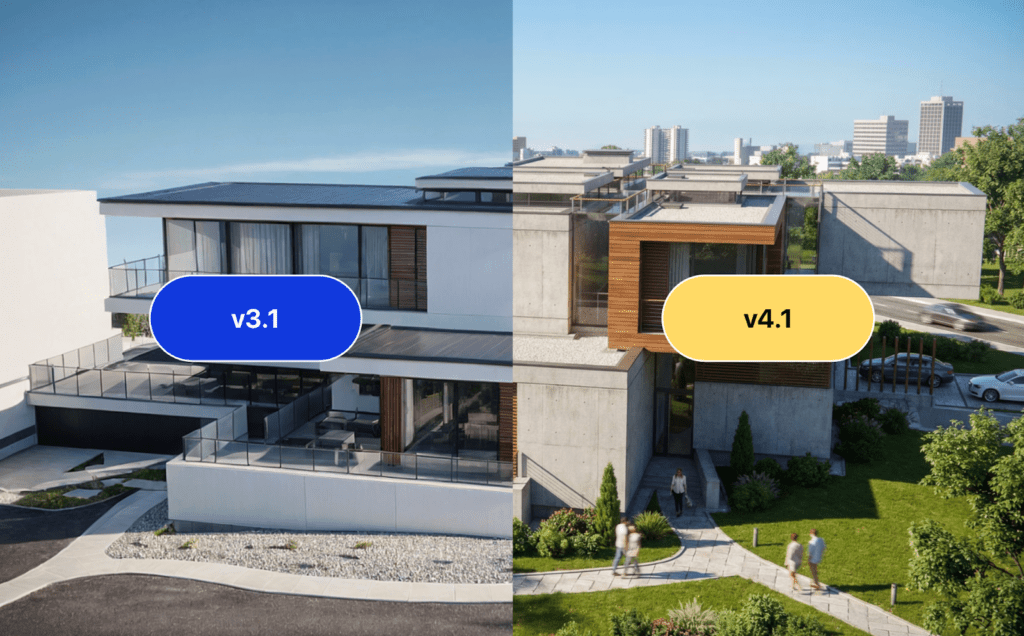
With the arrival of ArchDiffusion v4.1, AI architectural visualization has become more promising and powerful than ever. mnml.ai continues to strive toward delivering the most up-to-date, capable, and effective tools to meet users’ evolving design needs.
While v3.1 remains strong in its own right—and many users still prefer it over the newer engine—understanding the strengths of each version is key to maximizing their potential and achieving the best results for your projects. In this guide, we’ll take a quick yet informative look at how the two engines compare, what each one offers, and which is best suited to your specific goals.
Engines Overview
Before diving into the comparison, let’s take a quick look at what each engine brings to the table.
ArchDiffusion v4.1 is the latest engine from mnml.ai, designed to deliver significantly improved visualization quality over previous versions. It features stronger prompt adherence, higher native render resolution, and greater flexibility across a wide range of styles. Powered by ARX technology, it produces industry-grade visuals in a fraction of the time, while its built-in options streamline the workflow for a smoother, more efficient experience.
ArchDiffusion v3.1, on the other hand, is a well-loved legacy engine known for its simple and intuitive interface. It’s particularly well suited for early-phase design exploration, where speed and creative freedom are essential—allowing users to quickly experiment with form, style, and geometry.
Which Engine Is Best for You?
Let’s move on to the comparison itself. Below, we’ll evaluate both engines using the following criteria:
- Speed
- Accuracy
- Creativity
- Quality
- Price & Credit Usage
By looking at each engine through these parameters, you’ll be better equipped to identify which one aligns best with your design goals, workflow, and personal preferences.
1. Speed
To compare rendering speed, we measured the average generation time of each engine using a real-time timer. Based on manual testing, the results are as follows:
- ArchDiffusion v3.1: approximately 20–45 seconds per render
- ArchDiffusion v4.1: approximately 35–45 seconds per render
The data shows that v3.1 is, on average, around 15 seconds faster than v4.1. As a result, v3.1 clearly leads in this category.
Note: Actual rendering times may vary depending on network connection and system conditions.
2. Accuracy
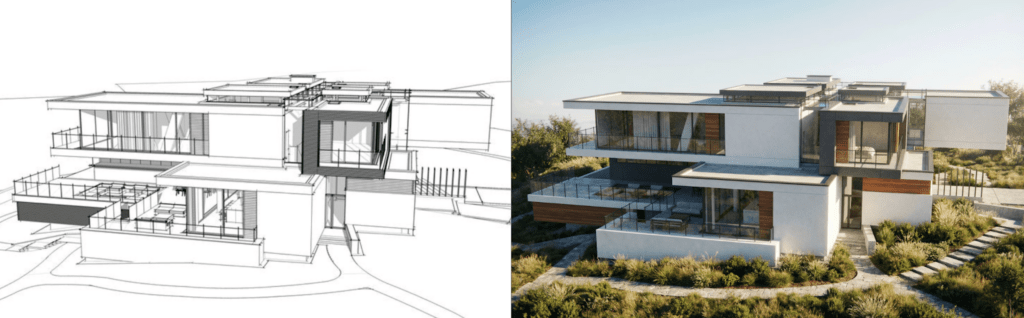
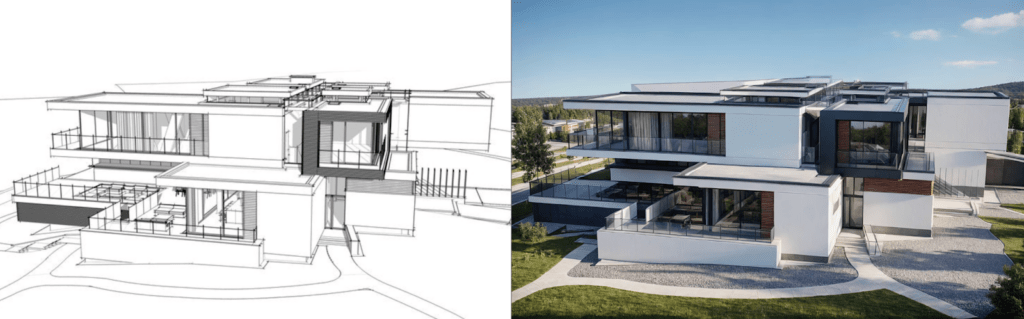
This criterion focuses on how well each engine preserves the geometry of the input image.
Exterior Sample
v4.1
v3.1
Interior Sample
v4.1
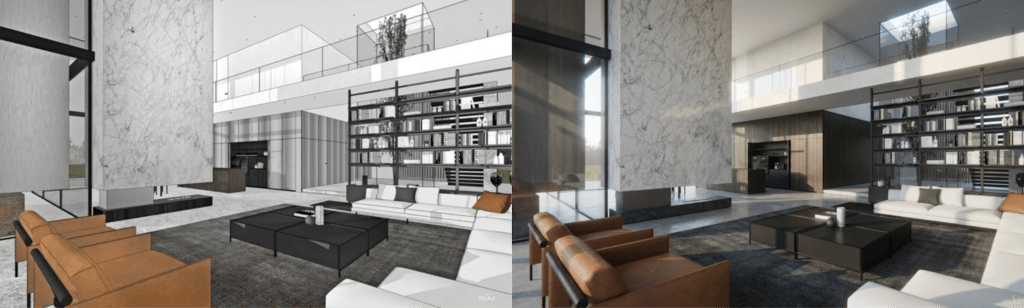
v3.1
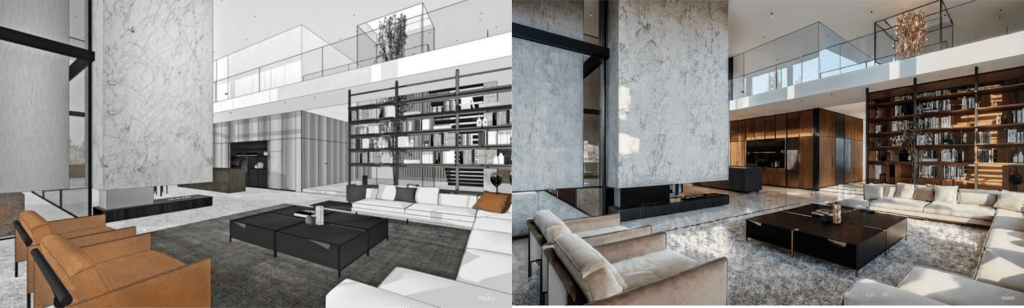
Across both exterior and interior samples, ArchDiffusion v3.1 continues to perform well in maintaining accurate geometry. However, ArchDiffusion v4.1 takes this a step further by producing smarter interpretations, more defined lines, and noticeably clearer results.
While both engines successfully retain the original geometry, v4.1 stands out for delivering more refined, visually striking, and client-ready outputs—making it the stronger choice in terms of overall accuracy and presentation quality.
3. Creativity
This category evaluates how each engine expands creative possibilities while complementing your design intent.
Exterior Sample
v4.1
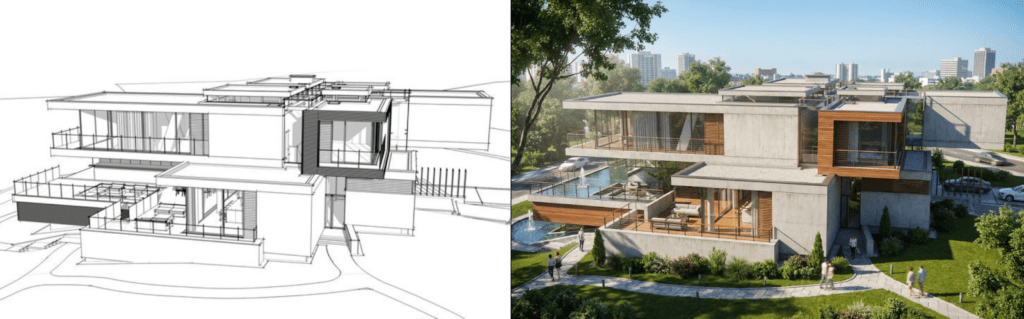
v3.1
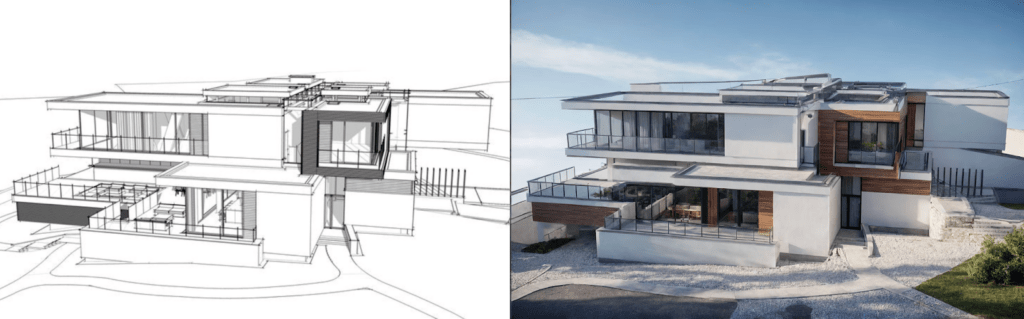
Interior Sample
v4.1
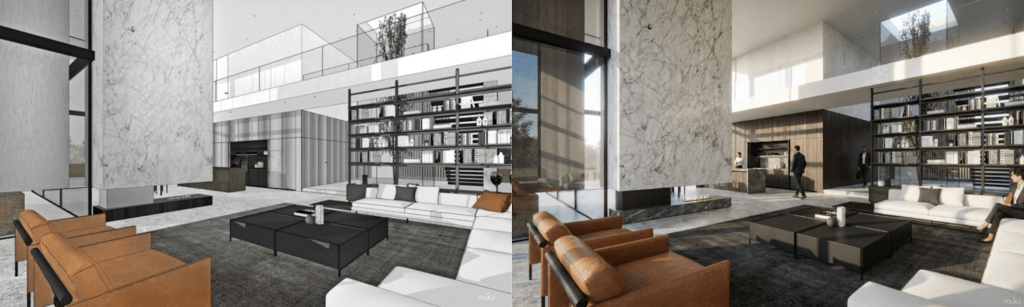
v3.1
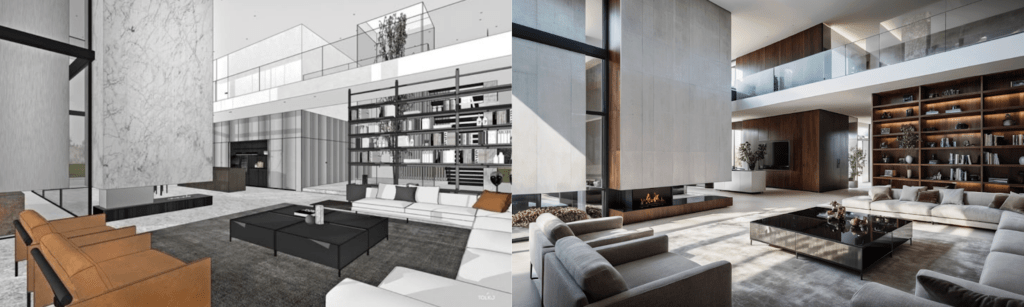
In exterior and interior samples alike, ArchDiffusion v3.1 remains a strong option for fast, iterative exploration. However, ArchDiffusion v4.1 offers a noticeably broader range of creative control and flexibility.
Beyond its improved accuracy and visual quality, v4.1 introduces built-in options that allow you to easily add elements such as trees, people, and other contextual details with just a click. You can also specify desired elements directly in the prompt, and the engine will intelligently incorporate them into the render.
Overall, v4.1 provides a richer environment for creative exploration—enabling greater expression and customization while still maintaining precision and high-end visual quality.
4. Quality
This section compares the overall output quality produced by each engine.
Exterior Sample
v4.1
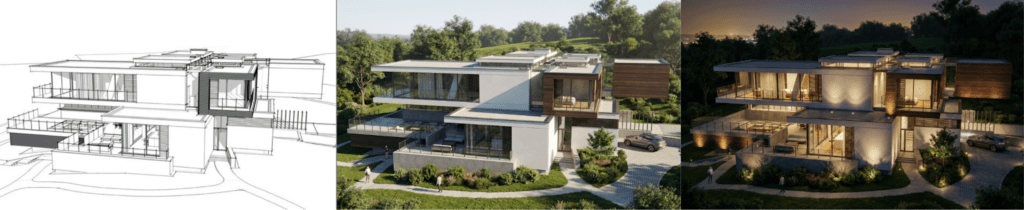
v3.1
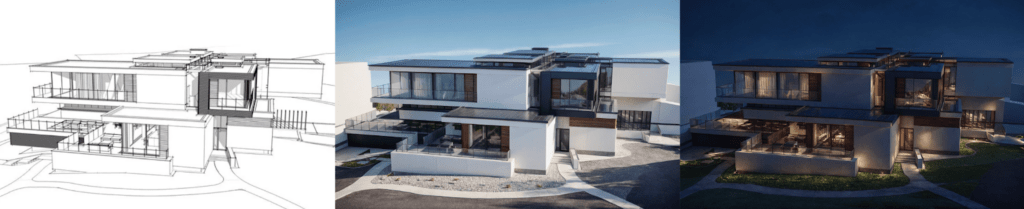
Interior Sample
v4.1

v3.1

ArchDiffusion v3.1 delivers solid results that work well for rapid exploration and concept development. Its outputs are reliable and visually coherent, making it a strong choice during early design stages.
However, if your goal is a client-ready render with high realism and the ability to achieve up to 4K-quality visuals, ArchDiffusion v4.1 clearly stands out. With sharper details, improved lighting, and a more polished finish, v4.1 offers a noticeable upgrade in visual fidelity.
In terms of overall quality, v4.1 takes the lead.
5. Price & Credit Usage
This section looks at how many credits each engine consumes per render.
mnml.ai offers a range of plans to suit different needs—whether you prefer monthly subscriptions, one-time credit packs, or enterprise solutions. All plans provide full access to the platform’s tools; the key difference lies in credit usage per engine. You can explore detailed pricing options on the mnml.ai pricing page.
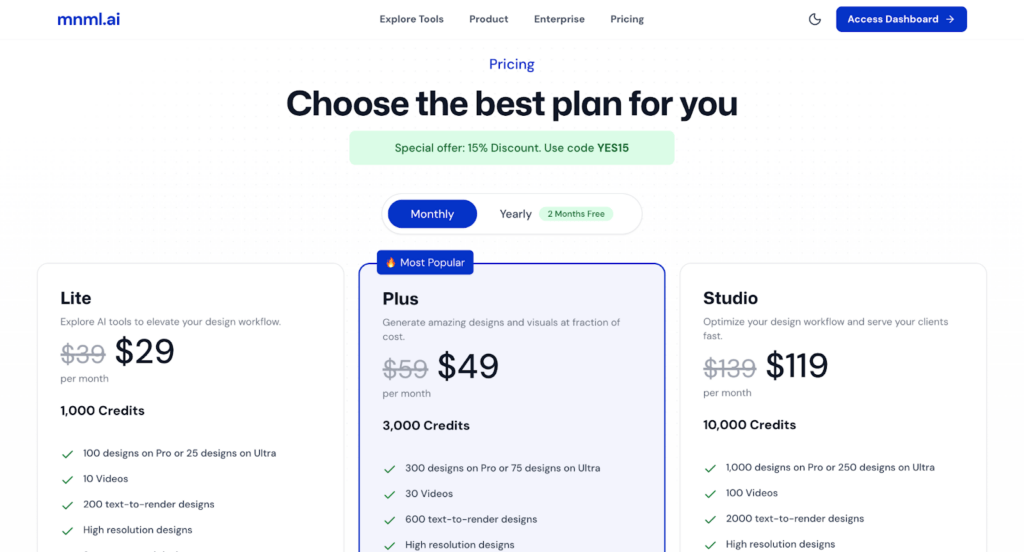
In terms of consumption:
- ArchDiffusion v3.1: 10 credits per render
- ArchDiffusion v4.1: 40 credits per render
If you’re in the early stages of design—exploring ideas, experimenting with concepts, or iterating freely—v3.1 is the more economical and flexible choice. On the other hand, if you have a clear direction and are aiming for a polished, client-ready output, v4.1 delivers the quality and refinement worth the higher credit cost.
Ultimately, both engines are designed to support your creative process—so feel free to explore and use them in ways that best serve your design goals.
Final Takeaways
- v3.1 is best for fast exploration, quick iterations, and lower credit usage.
- v4.1 excels in visual quality, accuracy, and client-ready outputs.
- Both engines maintain geometry well, but v4.1 delivers cleaner and more refined results.
- v4.1 offers greater creative control with built-in elements and stronger prompt adherence.
- The right choice depends on your workflow: v3.1 for ideation, v4.1 for final polish.
Used together, both engines form a powerful workflow—helping you move seamlessly from concept to client-ready visualization.